Thursday, March 7, 2013

In Class and HW - 3/7/13

Tonight's homework is to complete Assignment 10 and prepare for the check-in tomorrow on this week's material.


Assignment #10 - The Skinny on Fats

Procedure

1. Log into your account at fitday.com.

2. Pay attention to which version of fitday.com you are using.

a. Using Fitday 2 (the default version usually) - Highlight the “Reports” tab and then click on “Nutrition.” Then highlight the proteins bar (found on the left side).

b. Using Fitday Classic – Click on “Reports” tab (top right) and then click on “Nutrition Facts.”

3. Observe and record the following:

·      Your total fat intake for each day recorded
·      The number of calories from fat
·      The percentage of your caloric intake from fat

“The Skinny on Fats” Comprehension Questions

Answer the following questions to the best of your ability in complete sentences.

1. What inferences can you make from your observations of your fat intake? For example, do you feel as though you consume a lot of fat?

2a. Based on what you read and learned about today, what recommendations about fat intake, the sources of fat in one’s food, etc. would you make to a friend who is curious, but not knowledgeable about what to eat?

2b. Explain the rationale behind your recommendations.

2c. Which of the recommendations apply most or resonate most with you? Explain why.

3. Summarize what you learned about fats/lipids today. Be sure to include definitions/explanations in your own words.


Use the following links to learn more about the answers to your questions. Take notes on the answer to your question below today's lecture notes.

Fats and Cholesterol - The Bottom Line

Fats and Cholesterol: Out With the Bad, In With the Good - Table of Contents

Understanding Cholesterol

Science Exhibition Help

The Powerpoint presentation from yesterday's advisory

Wednesday, March 6, 2013

HW - 3/6/13


Assignment #9 - The Power of Protein!

Procedure

1. Log into your account at fitday.com.

2. Pay attention to which version of fitday.com you are using.

a. Using Fitday 2 (the default version usually) - Highlight the “Reports” tab and then click on “Nutrition.” Then highlight the proteins bar (found on the left side).

b. Using Fitday Classic – Click on “Reports” tab (top right) and then click on “Nutrition Facts.”

3. Observe and record the following:

·      Your total protein intake for each day recorded
·      The number of calories from protein
·      The percentage of your caloric intake from protein

“The Power of Protein!” Comprehension Questions

Answer the following questions to the best of your ability in complete sentences.

1. What inferences can you make from your observations of your protein intake? For example, do you feel as though you eat a lot of protein?

2. Explain why foods made from animals typically contain higher quality proteins than found in plant foods.

3. Propose an explanation for why diets high in protein are associated with higher rates of obesity and heart disease.

High-Protein Plant Foods


Do Athletes Need More Protein?

4. Using the class website or the handouts from class, read “Do Athletes Need More Protein?” or “High-Protein Plant Foods.” Summarize the content in the selection and explain how knowing about proteins in food can promote health and healthier eating.

5. Summarize what you learned about proteins today. Be sure to include definitions/explanations in your own words.

Tuesday, March 5, 2013

Notes 3/4/13 - 3/8/13

Monday's Notes on Calories

Tuesday's Notes on Carbohydrates

Definition – organic macromolecules that contain carbon, hydrogen, and oxygen in the ratio of CnH2nOn

Role – primarily to store energy – in some cases structure

Examples – monosaccharides - glucose – seldom found in food but used as body’s fuel
Fructose – very sweet, occurs naturally in fruits/veggies
Galactose – rare in food, found in lactose (milk sugar)

Disaccharides – sucrose – table sugar (glucose + fructose)
Lactose – sugar in milk (glucose + galactose)
Maltose – product of starch breakdown (glucose + glucose)

Oligosaccharides – short chains of carbohydrates – found in dried beans, peas, lentils, human milk

Polysaccharides – long chains of carbohydrates – starch (grains (wheat, rice, corn, oats), legumes (peas, beans, lentils) and tubers (potatoes and yams)).

Glycogen – animal starch, used to store carbs in liver and muscle

Fiber – carbs from plants that cannot be digested – ex. cellulose

Excess – extra energy is stored as glycogen and then fat typically – increased weight gain is associated with a variety of maladies – type 2 diabetes, heart disease

Deficiency – without the energy from carbohydrates, your body will use your protein and fat stores for energy – your brain only runs on glucose so different sources (ex. fat) must be converted to glucose – w/o carbs your liver cannot completely break down fat and produces ketone bodies – your cells can run on these but if they build up it can lead to ketosis making your blood dangerously acidic (and you can hallucinate)


Wednesday's Notes on Proteins


Definition – organic macronutrients made of amino acids (which contain C, H, O, N, sometimes others) – proteins have a 3D shape that determines their ability to function


Roles and examples– structure – ex. collagen, keratin
movement – ex. actin, myosin
enzymes – ex. amylase, lipase
hormones – ex. insulin
immune system – ex. antibodies
fluid balance – proteins in blood help attract fluid from in between cells
energy source – 4 kcal/gram
transport – help substances move into/out of cells

Sources – plants (legumes – ex. lentils, peas, soybean, tofu, grains, veggies, nuts) and animals (chicken, beef, pork, etc.) – animal protein is typically higher quality than plant protein (more variety of amino acids in proper proportions)

Excess – kidneys excrete protein normally so more protein can strain the kidneys – can also lead to loss of minerals like calcium – higher intake is associated with higher rates of obesity, heart disease, cancer, and osteoporesis

Deficiency – kwashiorkor – lack of protein – leads to edema (fluid in limbs), decrease in height/weight, dry/flaky skin, sores, brittle hair
Marasmus – lack of calories and protein – leads to wasting (loss of muscle and fat), drops in BMR, body temp., and a halting of growth


Thursday's Notes on Fats

Definition – organic molecules that dissolve in organic solvents like alcohol or acetone (non-polar, but not water (polar) – composed of fatty acids (carbon chains of varying lengths) -

Saturated fatty acids – fully loaded with hydrogen (no double bonds) – long chains are solid at room temp. while short chains are liquid
Unsaturated fatty acids – have one double bond (C=C) – liquid at room temp.
Polyunsaturated fatty acids – have multiple double bonds – liquid at room temp.
Trans fatty acids are a type of unsaturated fatty acid

Triglycerides – three fatty acids attached to a glycerol

Roles and examples
energy source
energy reserve – adipose tissue
insulation/protection
carry fat soluble compounds – ex. vitamins
make up cell membranes and hormones

Sources – cheeses, milk, animal proteins, oils, nuts

Excess – diets high in fat, saturated fat, and trans fat increase the risk of heart disease and several types of cancer

Deficiency – possible issues with mood (depression) and concentration – problems absorbing fat-soluble nutrients (A,D,E, and K)

In Class and HW - 3/5/13

Assignment #8 - Sweet, Sweet Carbohydrates

Procedure

1. Log into your account at fitday.com.

2. Pay attention to which version of fitday.com you are using.

a. Using Fitday 2 (the default version usually) - Highlight the “Reports” tab and then click on “Nutrition.” Then highlight the carbohydrates bar (found on the left side).

b. Using Fitday Classic – Click on “Reports” tab (top right) and then click on “Nutrition Facts.”

3. Observe and record the following:
  • Your total carbohydrate intake for each day recorded
  • The number of calories from carbohydrates
  • The percentage of your caloric intake from carbohydrates
Answer the following questions to the best of your ability in complete sentences.

1. What inferences can you make from your observations of your carbohydrate intake? For example, do you feel as though you eat a lot of carbohydrates? Do you eat mainly simple, refined carbohydrates or complex carbohydrates?

2. Some diets (ex. Atkin’s, South Beach, etc.) propose trying to minimize or eliminate carbohydrate sources such as sugar, bread, and grains from a person’s diet in order to promote weight loss. In some cases, adhering to these diets does produce weight loss in the short term.

Propose an explanation for this. In other words, why might removing carbohydrate sources such as bread and grains lead to weight loss?


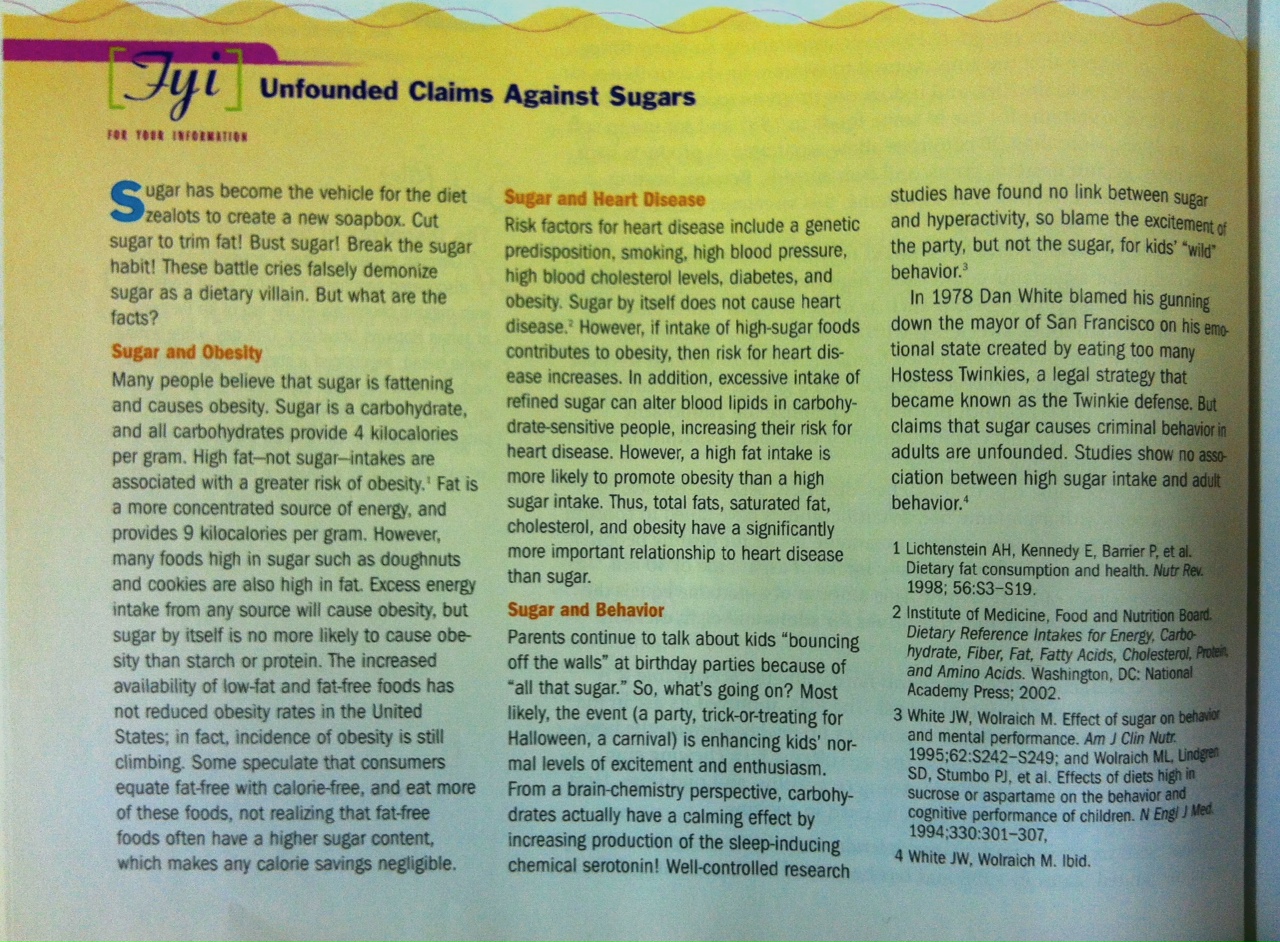
3. Using the class website or the handouts from class, read “The Glycemic Index of Foods: Useful or Useless” or “Unfounded Claims Against Sugars.” Summarize the content in the selection and explain how knowing about carbohydrates in food can promote health and healthier eating.


4. Summarize what you learned about carbohydrates today. Be sure to include definitions/explanations in your own words.

Monday, March 4, 2013

In class and HW - 3/4/13

Tonight's homework is to complete Assignment 7. See below.


Assignment #7 - What Is In a Calorie?

Procedure

1. Log into your account at fitday.com.

2. Pay attention to which version of fitday.com you are using.

a. Using Fitday 2 (the default version usually) - Highlight the “Reports” tab and then click on “Calories.”

b. Using Fitday Classic – Click on “Reports” tab (top right) and then click on “Calories Eaten Pie Chart.”

3. Observe and record the following:

·      Your total caloric intake
·      The number of calories from: fat, carbohydrates, and protein
·      The percentage of your caloric intake from fat, carbohydrates, and protein

4. Answer the following questions to the best of your ability in complete sentences.

1. What inferences can you make from your observations of the sources of your energy? For example, from which source did the majority of your calories come from?

2. Using the class website, learn more about the controversy regarding calories consumed late at night. Complete the readings and thoughtfully answer the following question:

Would you recommend against eating late at night? Be sure to support your answer and answer the question thoroughly – ie. if yes, under what conditions? Ex. “One should never eat late…” or “People should avoid eating late because…”


Resources for question 2:

Resource #1

Resource #2

Other myths and misconceptions regarding calories


3. Suppose you are supposed to consume 2,000 kcal worth of energy each day (remember that caloric needs are different in different people). If 55 percent of your calories should come from carbohydrates, 15 percent of your calories should come from proteins, and 30 percent of your calories should come from fats, then how many grams of each nutrient should you consume each day? Show your work.

4. Summarize what you learned about calories today. Be sure to include your own definition for what a calorie is.

Friday, March 1, 2013

HW - 3/1/13

This weekend's homework is to complete Assignment 6. The link to the reading and the questions are found below.

"The Ultimate Social Network" by Jennifer Ackerman


Assignment #6 - Scientific Reading Comprehension Questions

Answer all of the following questions to the best of your ability in complete sentences.

Pre-Reading Questions – Complete these BEFORE starting to read the article.

1. How do you feel about bacteria? For example, are they harmful? Beneficial? Explain your opinion.

2. How do you feel about antibiotics? For example, are they beneficial? Harmful? Explain your opinion.

Post-Reading Questions – Complete these AFTER finishing your reading of the article.

3. Summarize the article in a paragraph.

4. How does this article relate to what we have been discussing in class this week?

5. At this point, how do you feel about bacteria? Has your opinion changed? Stayed the same? Explain.

6. How do you feel about antibiotics? Has your opinion changed? Stayed the same? Explain.